Pre-Winter Septic Troubleshooting: Early Signs You Need Septic System Repair
What happens to shallow septic lines during a hard freeze? Apply these home maintenance tips and troubleshooting to protect your property before winter hits.
When homeowners in Antioch ask our team, "How Often Should I Pump My Septic Tank When Hosting Summer Guests?", the short answer depends entirely on your system's current capacity and the sudden surge in water volume you expect during peak summer heat. Are you confident your plumbing can handle ten people showering in a single weekend, or will your upcoming barbecue end with a flooded yard? Hosting family and friends drastically changes your household water usage overnight, turning a quiet, manageable plumbing system into a high-stress environment.
The primary risk during these large gatherings is a sudden hydraulic overload. This happens when a massive influx of wastewater overwhelms the tank and the drainfield faster than the system can process it. When you are planning for peak summer hosting weekends (July 4th, Labor Day), you face a critical decision: should you rely on your standard three-to-five-year maintenance schedule, or should you book a proactive pump-out before the first guest arrives?
Making the right call now prevents a messy, embarrassing disaster while your house is full of visitors. A simple evaluation of your tank's sludge levels and drainfield health can save you from a major plumbing catastrophe. To get ahead of the problem, scheduling a septic inspection is the best way to determine if you need preventative maintenance to avoid emergency septic tank replacement and repair during your party.
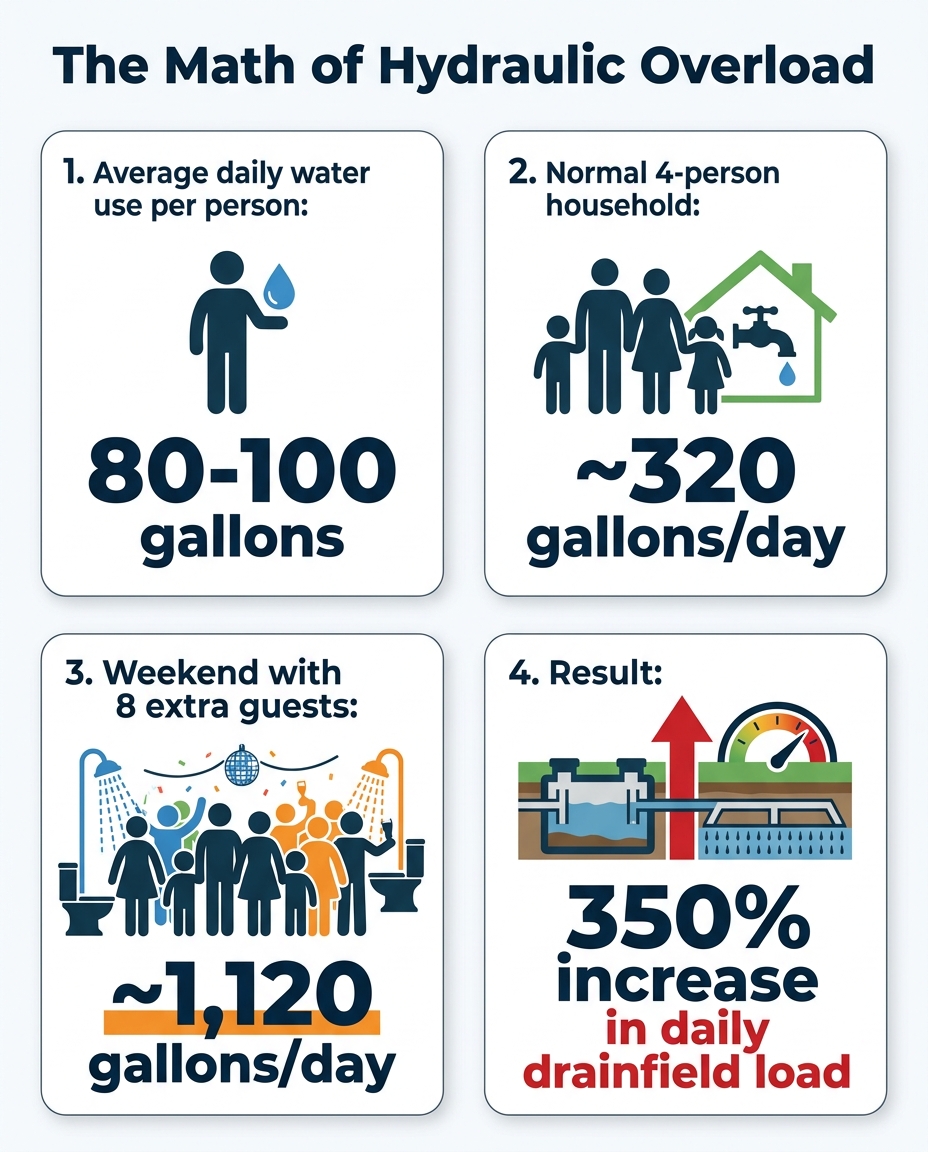
To understand why a weekend party can push a healthy plumbing system to the brink of failure, you have to look at the math of daily water consumption. The average person uses between 80 and 100 gallons of water per day. That covers flushing toilets, taking showers, washing hands, cooking, and doing laundry.
In our years of servicing properties throughout the Antioch / Chain O'Lakes region, our team sees firsthand how warm weather brings people to the water, causing household occupancy to jump drastically overnight. If you have a standard family of four, your system processes roughly 320 to 400 gallons of water daily. If you add eight overnight guests for a long weekend, you are suddenly asking that same system to process an extra 800 gallons of water every single day. Over a three-day weekend, that is well over 2,000 additional gallons of wastewater flowing directly into your tank and out to the drainfield.
A pattern we see often is the misconception that a septic tank only backs up when it is physically full of solid waste. In reality, a sudden massive water influx can flood the drainfield even if the tank has plenty of room for solids. This condition is known as hydraulic overload.
Your tank is designed to hold wastewater long enough for heavy solids to sink to the bottom (forming sludge) and lighter fats and oils to float to the top (forming scum). The relatively clear liquid in the middle, known as effluent, then slowly flows out into the drainfield. When your home experiences a massive spike in water usage from extra showers, back-to-back laundry loads, and constant toilet flushes, the water moves through the tank too quickly.
The consequences of rapid flow:
• Disrupted settling: High-velocity water stirs up the sludge layer at the bottom of the tank.
• Suspended solids: Waste that should stay in the tank gets pushed out into the drainfield lines.
• Clogged soil: Solid particles clog the porous soil in the drainfield, preventing the ground from absorbing liquid.
• System backup: With nowhere else to go, the wastewater eventually backs up into your home's lowest drains.

If you look up generic maintenance advice, you will likely find the standard Environmental Protection Agency (EPA) recommendation: pump your tank every three to five years. While this is a great baseline for a typical suburban home, our team at Countryside Plumbing Sewer and Septic frequently finds that it completely fails to account for the massive weekend hydraulic spikes common in vacation properties and seasonal homes.
EPA pumping charts are calculated based on two static numbers: the size of your tank (usually 1,000 to 1,500 gallons) and the number of permanent residents in the home. These charts assume a steady, predictable flow of wastewater 365 days a year. They do not factor in what happens when a house sits relatively quiet for three weeks and then suddenly hosts fifteen people for a hot summer holiday weekend.
During peak summer hosting weekends (July 4th, Labor Day), normal rules simply do not apply. A tank that is technically only half-full of solids might still fail because the sheer volume of liquid rushing through it overwhelms the drainfield's absorption rate. Seasonal usage patterns require a much more flexible, scenario-based approach to pumping and maintenance.
• Occupancy — Standard Year-Round Home: Consistent (e.g., 4 people daily) — Lake-House / Weekend Hosting Reality: Highly variable (jumps from 2 to 12+ overnight)
• Water Flow — Standard Year-Round Home: Steady, predictable daily average — Lake-House / Weekend Hosting Reality: Massive, concentrated spikes over 48-72 hours
• Drainfield Rest — Standard Year-Round Home: Constant low-level saturation — Lake-House / Weekend Hosting Reality: Long resting periods followed by sudden flooding
• Pumping Strategy — Standard Year-Round Home: Strict 3-5 year calendar schedule — Lake-House / Weekend Hosting Reality: Proactive pumping before major high-capacity events
When your household capacity triples in 24 hours, you cannot rely on a generic chart. You have to evaluate the actual sludge accumulation and the resting capacity of your drainfield to ensure the system can handle the impending surge.
While most homeowners focus entirely on the tank itself, the drainfield is actually the most common bottleneck during high-usage events. The drainfield is a network of perforated pipes laid in gravel trenches underground. Its job is to slowly release the liquid effluent into the soil, where natural bacteria filter and purify it.
In the Antioch / Chain O'Lakes region, our technicians regularly observe that local soil composition plays a huge role in how quickly water absorbs. If the ground is already saturated from heavy summer rain, your drainfield's capacity to take on an extra 1,000 gallons of wastewater is severely diminished. When the soil cannot absorb the water fast enough, the liquid backs up into the tank, and eventually into your home.
Before your guests arrive, pay close attention to how your plumbing is behaving under normal conditions. If your system is already struggling with a family of four, it will absolutely fail when you add ten more people. Look for these warning signs:
1. Monitor your lowest drains: Showers, tubs, and floor drains in the basement or ground floor are the first places wastewater will appear if the system is backing up. If these drains are gurgling or emptying slowly, your drainfield is likely saturated.
2. Inspect the yard over the drainfield: Walk over the area where your drainfield is buried. If the grass is unusually lush, bright green, or the ground feels spongy and soggy underfoot, effluent is pooling near the surface instead of absorbing downward.
3. Check for mild odors: A healthy system traps sewer gases inside the tank. If you smell a distinct sewage odor in your yard or near your household drains, the system is struggling to vent and process waste properly.
4. Evaluate specialized equipment: If your property uses an aerobic treatment unit (which uses oxygen to break down waste faster), these systems have mechanical components that must be functioning perfectly to handle heavy loads. Scheduling aerobic inspection services ensures the aerator pump and alarms are ready for the surge.
Catching these signs early gives you time to pump the tank, which provides the drainfield a temporary break to dry out and recover before the heavy usage begins.
If you are expecting a large crowd, hoping for the best is not a reliable plumbing strategy. Taking proactive steps ensures your system has the maximum possible capacity to handle the extra volume.
How do you know if you actually need to pump the tank before the event? Run through this quick checklist to evaluate your risk level:
• Time since last pump: Has it been more than two years since your last service? If yes, and you are expecting a massive crowd, pumping now is highly recommended.
• Current household size vs. guest count: Are you doubling or tripling your household size for more than two days? The longer the guests stay, the higher the risk of hydraulic overload.
• Recent weather conditions: Has the region experienced heavy rainfall recently? Saturated ground means your drainfield is already working at a disadvantage.
• System history: Have you noticed any slow drains or gurgling toilets in the past month? Do not ignore these early warning signs.
To completely eliminate the guesswork, our team at Countryside Plumbing Sewer and Septic offers proactive septic inspections to ensure peace of mind before the guests arrive. A professional can measure the exact sludge and scum layers in your tank and tell you definitively if a pump-out is necessary.
Even with an empty tank, you still need to manage the flow of water into the system during peak summer hosting weekends (July 4th, Labor Day). Implementing a few simple water conservation rules can prevent hydraulic overload:
• Stagger shower times: Ask guests to space out their showers. Ten showers back-to-back push hundreds of gallons into the tank at once. Spacing them out morning and night gives the drainfield time to process the liquid.
• Halt the laundry: Do all your pre-party washing (sheets, towels) several days before guests arrive. Do not run the washing machine at all while the house is full.
• Minimize dishwasher use: Use high-quality paper plates and compostable utensils for large outdoor barbecues to avoid running the dishwasher multiple times a day.
• Listen to your system: Pay attention to how your plumbing sounds. If you hear septic aerator strange noises or toilets bubbling, mandate an immediate pause on water usage.
• Consider portable alternatives: If you are hosting a massive outdoor gathering (like a family reunion or backyard wedding with 30+ people), rent portable restrooms. Completely bypassing your home's plumbing is the safest way to protect your drainfield.
Yes, if it has been over a year since your last pump and you are expecting a massive increase in overnight guests, scheduling a pump-out is a smart preventative measure. Pumping removes the accumulated sludge and scum, giving the tank its absolute maximum liquid volume to handle the sudden influx of wastewater. This extra buffer time can prevent the drainfield from flooding during a busy weekend.
When too many guests use the plumbing, the system experiences a state of hydraulic overload. Because water is entering the tank faster than it can slowly exit into the drainfield, the rapid flow stirs up the settled sludge at the bottom. This turbulent wastewater pushes raw, unfiltered solids out into the drainfield lines, which can cause severe clogs, yard flooding, or sewage backing up into your home's lower drains.
A standard 1,000-gallon tank is typically designed to support a three-bedroom home with about four permanent occupants. While the system can handle short-term spikes for a few hours, continuous heavy usage by eight or more people over several days will rapidly overwhelm the drainfield. The issue is not just the physical size of the tank, but the absorption speed of the soil in the Antioch / Chain O'Lakes region.
The most effective way to prevent a backup is to dramatically reduce water usage during the event by staggering showers and avoiding excessive laundry the week prior. You should also schedule a preventative inspection to ensure your sludge levels are low. For large outdoor-only gatherings, consider renting portable restroom facilities so guests do not stress your residential plumbing system at all.
Yes, sudden heavy water usage can cause permanent, irreversible damage to the drainfield. If the high water velocity flushes solid waste and grease into the perforated pipes, it creates a thick biological mat that permanently clogs the soil. Once the soil pores are sealed by this waste, the drainfield can no longer absorb water, often requiring a complete and costly replacement of the trench lines.
Preparation is the ultimate key to avoiding devastating plumbing disasters during important family events. When you are planning for peak summer hosting weekends (July 4th, Labor Day), the last thing you want to worry about is a flooded yard or a backed-up basement shower. Understanding the limits of your plumbing and the realities of hydraulic overload allows you to make smart, proactive decisions.
If you are unsure about your system's current capacity, or if you have noticed your drains running a bit slower than usual, talk to an expert before the invitations go out. A quick professional evaluation is always easier, cheaper, and far less stressful than dealing with a mid-party sewage backup. And if the worst does happen during a busy holiday weekend, Countryside Plumbing Sewer and Septic provides reliable emergency response to get your system back online, ensuring your home remains safe and comfortable for every guest.
See why homeowners trust us for reliable, responsive service and lasting plumbing solutions.

Jordan and his team are very responsive and helpful with all questions and issues related to our septic system. I can reference them with the highest regards!
Jordan is a great guy who seems to genuinely care about delivering quality work. Not only did he fix the problem quickly and efficiently, but also pointed out that the ejector pump in my basement had installed the wrong kind and that there were some other parts used that are not up to code.
Had a great experience with Countryside. Called with a fairly urgent issue and Jordan was responsive and out the house fast. Spent hours diagnosing my problem. Prices were competitive and he took the time to explain the situation and options. Highly recommend.
I reached out to Countryside this past June when the pipe from my house to the septic tank broke. Jordan responded to my call quickly, gave me a very reasonable quote, and immediately fit me into his schedule- which I was extremely thankful for because my yard was getting pretty smelly. Jordan is an expert in his field.
Jordan and his crew at Countryside just installed and hooked up a new septic tank for us. We could not be happier with the result! They are professional, easy to talk to, and kind. We highly recommend them,
Jordan and his team are very responsive and helpful with all questions and issues related to our septic system. I can reference them with the highest regards!
Jordan is a great guy who seems to genuinely care about delivering quality work. Not only did he fix the problem quickly and efficiently, but also pointed out that the ejector pump in my basement had installed the wrong kind and that there were some other parts used that are not up to code.
Had a great experience with Countryside. Called with a fairly urgent issue and Jordan was responsive and out the house fast. Spent hours diagnosing my problem. Prices were competitive and he took the time to explain the situation and options. Highly recommend.
I reached out to Countryside this past June when the pipe from my house to the septic tank broke. Jordan responded to my call quickly, gave me a very reasonable quote, and immediately fit me into his schedule- which I was extremely thankful for because my yard was getting pretty smelly. Jordan is an expert in his field.
Jordan and his crew at Countryside just installed and hooked up a new septic tank for us. We could not be happier with the result! They are professional, easy to talk to, and kind. We highly recommend them,
Jordan and his team are very responsive and helpful with all questions and issues related to our septic system. I can reference them with the highest regards!