Pre-Winter Septic Troubleshooting: Early Signs You Need Septic System Repair
What happens to shallow septic lines during a hard freeze? Apply these home maintenance tips and troubleshooting to protect your property before winter hits.
A brand new motor might run perfectly under normal conditions, but there is a major misconception that a fresh installation automatically makes a home immune to flooding. Why We Recommend Adding a Battery Backup When Replacing Your Primary Sump Pump comes down to one undeniable fact: even the most powerful plumbing equipment is completely useless without electricity. Relying on a single primary sump pump leaves basements highly vulnerable, especially when late-summer heavy storms roll through and knock out the local power grid.
When planning your plumbing services, evaluating a sump pump replacement is the perfect decision point to upgrade your entire water management strategy. Proactive upgrades prevent emergency water damage before it ever starts. Late-summer severe weather acts as a primary catalyst for disaster because it brings both torrential rainfall and sudden, localized power outages at the exact same time. Your new pump might be mechanically flawless, but if the grid goes dark while the water table is rapidly rising, your basement is entirely unprotected.
As local plumbers who actively respond to post-storm flooded basements, we see firsthand that mechanical failure is only half the battle. One local homeowner reached out to our team over a weekend when their cellar filled with water due to a burned-out sump pump. We promptly replaced the failed pump—and subsequently a hot water heater that had also sustained damage—restoring their dry basement within their timeline. But this highlights a distinct pattern we see across Antioch and surrounding areas: single-pump systems carry inherent risks.
When evaluating your home's protection, consider these critical facts:
1. Mechanical failure is predictable: The average lifespan of a primary sump pump is roughly 7 to 10 years, meaning wear and tear will eventually take its toll.
2. Power failure is the primary culprit: FEMA flood damage statistics consistently show that the vast majority of basement flooding events occur due to power outages, not because the pump itself broke down.
3. Weather patterns dictate the risk: Historical weather data shows a high frequency of late-summer severe thunderstorm warnings that coincide directly with local grid interruptions.
A primary pump relies entirely on your home's alternating current (AC) electrical grid. It plugs into a standard wall outlet, and as long as the power flows, the motor spins. However, heavy rainfall almost always accompanies high winds, lightning strikes, and falling tree limbs. This makes power outages highly likely during the exact moments when peak water table levels demand maximum pumping capacity. A standalone unit has no secondary power source; when the house goes dark, the pump stops instantly, regardless of how much water is pouring into the sump pit.
Even the highest-capacity, premium primary pump is nothing more than a heavy piece of metal without electricity. During a torrential downpour, the ground surrounding your foundation quickly reaches saturation. Hydrostatic pressure forces groundwater into your drain tiles and straight into the sump basin. If the pump is inactive for even a single hour during a severe storm, water can rise rapidly, overtop the basin, and spread across your basement floor. Grid interruptions are the true enemy because they neutralize your primary defense precisely when you need it most.
Deciding how to protect your home requires a clear understanding of what you gain by stepping up to a dual system. We saw the benefits firsthand with a customer during summer flooding who urgently needed a new sump pump; by installing both a fresh primary unit and a battery backup system simultaneously, they finally gained true peace of mind against late-summer heavy storms. Here is an objective look at how the two setups compare.
• Power Source — Single Primary Pump Setup: Relies 100% on the municipal electrical grid. — Dual System (Primary + Battery Backup): Primary uses the grid; backup uses an independent DC battery.
• Mechanical Redundancy — Single Primary Pump Setup: Zero backup. If the motor or float switch fails, the basement floods. — Dual System (Primary + Battery Backup): Secondary pump takes over instantly if the primary unit experiences mechanical failure.
• Severe Weather Protection — Single Primary Pump Setup: Highly vulnerable to grid drops during thunderstorms and high winds. — Dual System (Primary + Battery Backup): Fully protected. The battery supplies hours of intermittent pumping during outages.
• High-Volume Assistance — Single Primary Pump Setup: Can be overwhelmed by flash flooding if the inflow exceeds pump capacity. — Dual System (Primary + Battery Backup): The backup can run simultaneously with the primary to handle extreme water influx.
The most glaring vulnerability of a single-pump setup is its total reliance on continuous utility power. Beyond the grid, there is also the risk of mechanical isolation. If the primary float switch gets stuck against the side of the basin, or if the intake screen clogs with debris, there is no secondary system to take over. You are placing the entire safety of your home's foundation and finished basement on a single mechanical switch and a single power cord.
A battery backup system provides a seamless transition to direct current (DC) battery power the moment AC power drops. Furthermore, it provides total mechanical redundancy. The backup system features its own independent float switch, positioned slightly higher in the pit than the primary switch. If the main pump fails to activate for any reason—whether due to a power outage, a blown fuse, or a jammed float—the rising water triggers the secondary switch, activating the backup pump automatically.
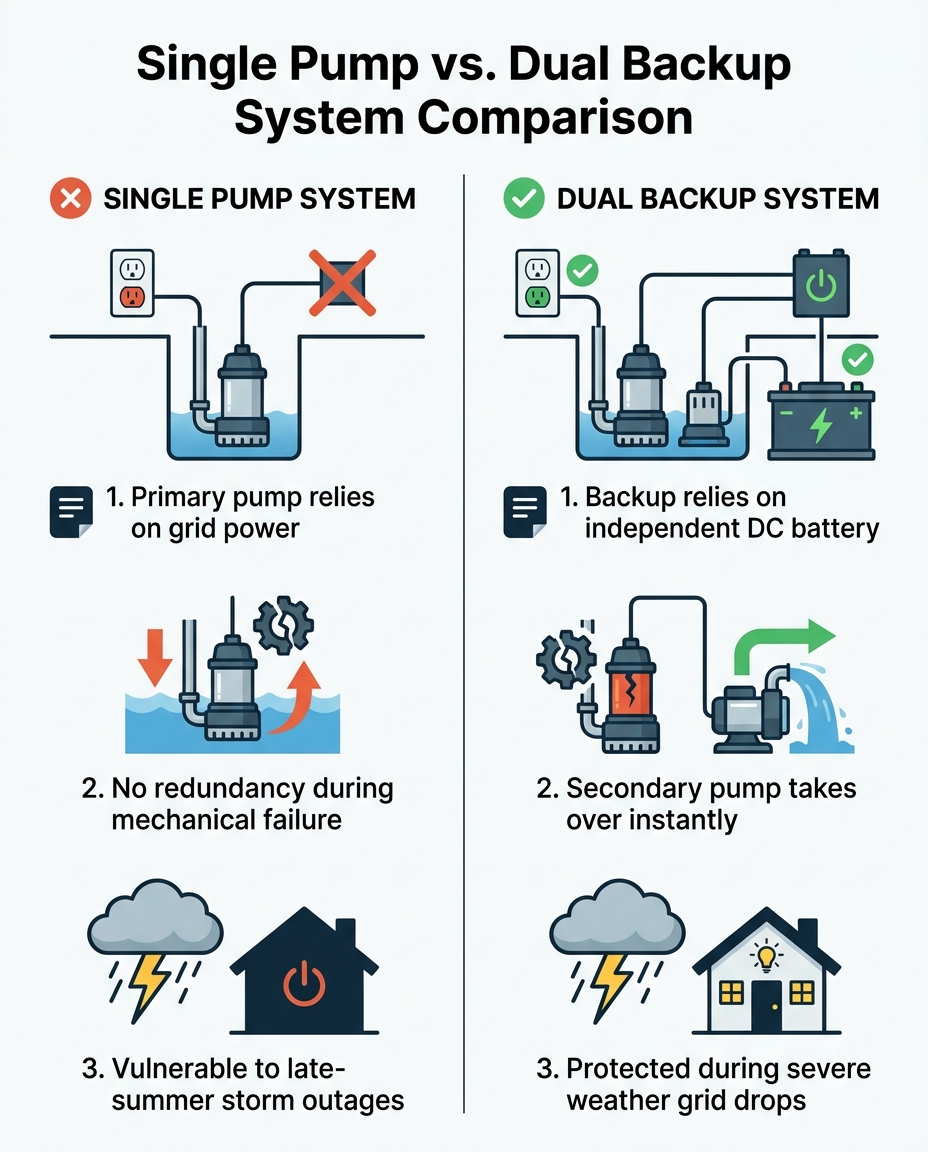

Upgrading to a dual system during an active replacement project is the most efficient choice you can make for your home's water management system. Another customer recently called us needing a backup sump pump while also dealing with hot water odor issues; we installed the backup unit alongside an in-line filter for the hot water, solving multiple issues efficiently in one streamlined visit. Combining upgrades saves time and ensures everything works in harmony.
When a professional is already in your basement replacing the main unit, the sump pit is open, and the discharge pipes are exposed. This prevents the stress of trying to retrofit a backup system during an active storm watch or dealing with a late night plumbing issue when the water is already rising. Installing both systems at once avoids the logistical hassle of scheduling two separate installation visits. It also allows the technician to properly size the basin and install the necessary dual check valves all at once, ensuring water doesn't cycle back into the pit.
Installing both units simultaneously ensures the primary and backup systems are perfectly calibrated to work together without interference. The technician ensures the float switches are staggered correctly so the backup only runs when absolutely necessary. Furthermore, it guarantees the power supply, trickle charger, and heavy-duty battery housing are appropriately situated on a secure platform above the floor, keeping the electronics safe and accessible for future maintenance across Antioch and surrounding areas.
Understanding the technical capabilities of a backup system can provide immense reassurance when the sky turns dark and the wind picks up. These systems are highly engineered to operate completely hands-off, meaning you don't need to trudge down to the basement with a flashlight to turn anything on when the power cuts out.
The intelligence of a dual system lies in its automatic switch-over mechanisms.
1. Constant Monitoring: The system's control unit constantly monitors the electrical current coming from the wall outlet, as well as the water levels in the pit.
2. Instant Switch-Over: The moment it detects a drop in primary AC power, it switches to the DC battery circuit.
3. Hands-Free Operation: The secondary float switch activates the backup pump instantly as water rises, requiring zero manual intervention from the homeowner.
Not all batteries are created equal. Most high-quality backup systems utilize either AGM (Absorbent Glass Mat) or deep cycle marine batteries. These are specifically designed to be discharged and recharged repeatedly without losing capacity. During late-summer heavy storms, a fully charged backup battery can typically run the pump continuously for several hours, or intermittently for days, depending on the volume of water entering the pit. When the grid power is eventually restored, the system's built-in trickle charger automatically recharges the battery so it is ready for the next weather event.
Additionally, modern smart backup systems include audible decibel alarms and even Wi-Fi monitoring alerts. These features notify homeowners via smartphone when the primary power has failed and the backup system is actively running, ensuring you are never caught off guard.
The decision to upgrade often comes down to weighing the practical impact of the installation against the devastating reality of disaster recovery. A flooded basement leads to severe damage of personal items, drywall, flooring, and even foundational integrity. The one-time logistical effort of adding a backup system pales in comparison to the massive disruption of emergency water extraction, demolition, and remediation.
The Problem: Standing water in an enclosed basement space creates a highly destructive environment. The Cause: When a single pump fails, groundwater seeps through the foundation, soaking into porous concrete, drywall, and wooden framing. The Solution: A dual system proactively ejects this water before it ever breaches the top of the pit. Preventing standing water is critical, as moisture quickly leads to rapid mold growth in dark, enclosed basement spaces. Protecting finished basements and stored valuables requires keeping the environment completely dry, which is only possible with continuous pumping power.
The Problem: Severe water intrusion doesn't just ruin drywall; it can complicate other lower-level plumbing fixtures. The Cause: When a basement floods, the excess water can overwhelm floor drains and interfere with the home's overall drainage ecosystem. The Solution: Maintaining a dry basement through a dual pumping system protects the entire property. If flooding is allowed to persist, the resulting hydrostatic pressure and debris can lead to complex drainage failures that may eventually necessitate extensive sewer repair. Proactive water management ensures that one point of failure doesn't cascade into multiple, compounding plumbing emergencies across your home in Antioch and surrounding areas.
Is a battery backup sump pump worth it?
Yes, a battery backup sump pump is widely considered one of the best investments for protecting a home's lower level. It provides automatic flood protection during power outages, which are the leading cause of basement flooding. The peace of mind and protection against extensive water damage make it highly worthwhile.
Can you add a battery backup to an existing sump pump?
You can definitely retrofit a battery backup system to work alongside an existing primary pump. A professional plumber will install the secondary pump in the same basin, staggering the float switches and modifying the discharge piping. However, if your primary pump is already aging, it is often more efficient to replace both units simultaneously.
How long does a sump pump battery backup last during an outage?
A fully charged, high-quality deep cycle battery can generally power a backup pump continuously for 5 to 7 hours. Because sump pumps usually run intermittently rather than continuously, a healthy battery can often protect a home for one to three days during a standard power outage, depending on the severity of the rainfall.
Does a backup sump pump run at the same time as the primary?
Under normal conditions, the backup pump remains on standby and does not run while the primary pump is operating. However, if an unusually heavy influx of water overwhelms the primary pump's capacity, the water will continue to rise until it triggers the backup's float switch, allowing both pumps to run simultaneously to clear the basin.
Why upgrade to a dual sump pump system during a replacement?
Upgrading during a replacement is the most efficient and practical time to enhance your system. The plumbing technician is already configuring the sump pit, sizing the check valves, and adjusting the PVC discharge lines. Doing it all at once ensures seamless calibration between the two pumps and saves you the hassle of a secondary installation visit.
What happens if my primary pump fails but the power is still on?
If the primary pump suffers a mechanical failure—such as a jammed float switch or a burned-out motor—while the house still has grid power, the backup system will still activate. The rising water will trigger the secondary float switch, and the backup pump will seamlessly take over the heavy lifting to keep your basement dry.
Relying on a single pump leaves your home vulnerable to the unpredictable nature of severe weather and sudden grid failures. When you are ready to evaluate a comprehensive sump pump replacement, choosing a dual system provides the ultimate reassurance. You deserve a clear, objective solution that delivers continuous protection, ensuring your basement remains dry and your home remains secure no matter what happens to the power lines outside.
See why homeowners trust us for reliable, responsive service and lasting plumbing solutions.

Jordan and his team are very responsive and helpful with all questions and issues related to our septic system. I can reference them with the highest regards!
Jordan is a great guy who seems to genuinely care about delivering quality work. Not only did he fix the problem quickly and efficiently, but also pointed out that the ejector pump in my basement had installed the wrong kind and that there were some other parts used that are not up to code.
Had a great experience with Countryside. Called with a fairly urgent issue and Jordan was responsive and out the house fast. Spent hours diagnosing my problem. Prices were competitive and he took the time to explain the situation and options. Highly recommend.
I reached out to Countryside this past June when the pipe from my house to the septic tank broke. Jordan responded to my call quickly, gave me a very reasonable quote, and immediately fit me into his schedule- which I was extremely thankful for because my yard was getting pretty smelly. Jordan is an expert in his field.
Jordan and his crew at Countryside just installed and hooked up a new septic tank for us. We could not be happier with the result! They are professional, easy to talk to, and kind. We highly recommend them,
Jordan and his team are very responsive and helpful with all questions and issues related to our septic system. I can reference them with the highest regards!
Jordan is a great guy who seems to genuinely care about delivering quality work. Not only did he fix the problem quickly and efficiently, but also pointed out that the ejector pump in my basement had installed the wrong kind and that there were some other parts used that are not up to code.
Had a great experience with Countryside. Called with a fairly urgent issue and Jordan was responsive and out the house fast. Spent hours diagnosing my problem. Prices were competitive and he took the time to explain the situation and options. Highly recommend.
I reached out to Countryside this past June when the pipe from my house to the septic tank broke. Jordan responded to my call quickly, gave me a very reasonable quote, and immediately fit me into his schedule- which I was extremely thankful for because my yard was getting pretty smelly. Jordan is an expert in his field.
Jordan and his crew at Countryside just installed and hooked up a new septic tank for us. We could not be happier with the result! They are professional, easy to talk to, and kind. We highly recommend them,
Jordan and his team are very responsive and helpful with all questions and issues related to our septic system. I can reference them with the highest regards!