Pre-Winter Septic Troubleshooting: Early Signs You Need Septic System Repair
What happens to shallow septic lines during a hard freeze? Apply these home maintenance tips and troubleshooting to protect your property before winter hits.
A draining sink or a flushing toilet does not necessarily mean your plumbing system is permanently fixed, especially when you are weighing the decision of hydro-jetting vs. snaking for tree root intrusions during peak summer growth. In our years serving the community, the most common misconception our team at Countryside Plumbing Sewer and Septic encounters is that restored water flow equals a resolved problem. When a main sewer line backs up, the immediate relief of watching wastewater finally recede can create a false sense of security. However, if the underlying cause is a mature root mass, a slightly improved flow rate is nothing more than a temporary pause in an ongoing structural attack.
Mature tree root intrusions aggressively seek out the consistent water and nutrient sources found inside underground sewer lines. Once they breach the pipe, they do not leave willingly. This creates a critical decision point for homeowners: deciding whether to pay repeatedly for standard cabling services or to invest in a comprehensive scouring method for a long-term fix. Before deciding on a treatment, it helps to understand the mechanics behind professional drain cleaning and when a temporary fix needs to become a permanent sewer repair.
To make an informed choice about your wastewater infrastructure, you need an objective breakdown of how these two distinct clearing methods interact with root biology. Traditional augers and high-pressure water jets perform entirely different mechanical functions inside a pipe. Understanding these differences is the only way to break the cycle of recurring backups.
Tree roots do not grow at a consistent rate year-round. During the hottest months of the year, environmental and biological factors combine to make root intrusions particularly severe. High canopy transpiration rates—the process where trees release water vapor through their leaves—drive aggressive root expansion. As the sun beats down and moisture evaporates from the foliage, the tree's root system must work overtime to pull replacement water from the surrounding soil.
When the soil dries out, the roots naturally migrate toward the nearest source of consistent moisture. Underground sewer lines provide a steady flow of water, nutrients, and oxygen. Furthermore, the temperature difference between the cool wastewater and the hot summer soil creates condensation on the outside of the pipe, turning the entire sewer line into an incredibly attractive target for thirsty vegetation.
The sheer force of nature: The physics of root intrusion are staggering. Tree roots can exert hundreds of pounds of pressure per square inch as they expand. This immense hydraulic pressure allows them to penetrate tiny fissures, microscopic cracks, or loose joints in aging underground pipes. Once inside, the roots multiply rapidly, forming a dense, net-like blockage that catches paper and waste.
Here in Antioch IL, our crews see firsthand how the specific climate context plays a massive role in how fast these blockages form. Heavy summer thunderstorms often saturate the ground, encouraging roots to spread horizontally. When those storms are immediately followed by stretches of intense heat and warm soil conditions, the environment becomes ideal for rapid, aggressive root intrusion. The contrast between the rapidly drying surrounding soil and the moisture-rich environment inside the sewer line forces roots to exploit any available entry point.
• Increased metabolic rates: Trees process nutrients and water much faster during the summer months, leading to explosive cellular growth at the root tips.
• Moisture gradients: Roots possess hydrotropism, meaning they naturally sense and grow toward higher moisture concentrations, which peak inside your sewer line during dry spells.
• Nutrient density: Wastewater contains phosphorus and nitrogen, which act as high-grade fertilizers, supercharging the root mass once it breaches the pipe wall.
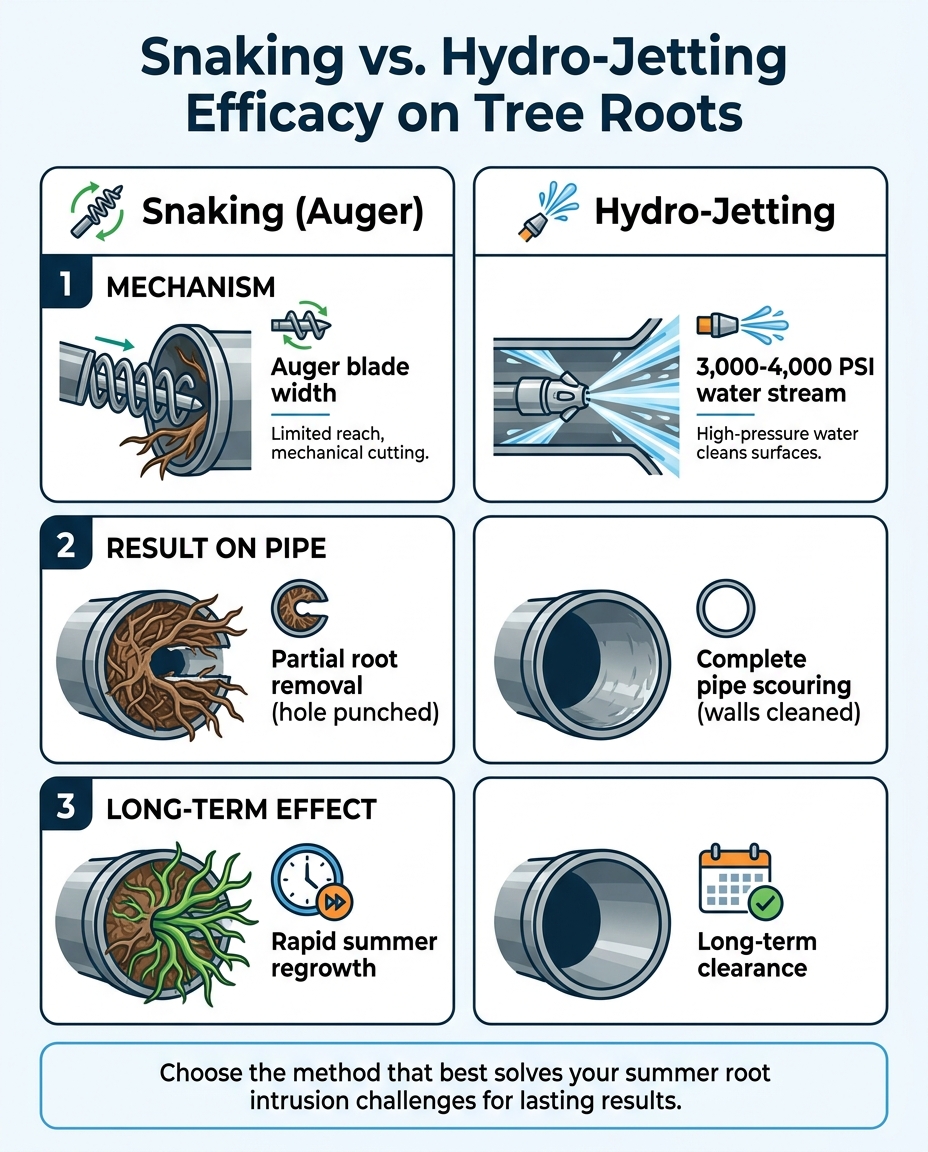
To understand why a clogged pipe often backs up again shortly after a service call, you have to look at the mechanical action of traditional snaking. A plumber's snake, or sewer cable, utilizes a heavy-duty steel wire with a rotating auger blade attached to the end. The machine feeds this spinning cable down the line to physically cut through blockages.
While providing an Antioch drain cleaning service, our plumbers find that a standard auger is highly effective for clearing soft blockages like paper or grease wads, but it faces a critical limitation when encountering mature tree roots. The auger blade can only clear a path as wide as the blade itself. Because the blade must be smaller than the pipe's diameter to navigate turns and joints, it strictly punches a hole directly through the center of the root mass.
1. Initial contact: The spinning blade meets the dense root mass and begins tearing through the fibrous material.
2. Center clearing: The auger pushes through the middle of the pipe, restoring immediate water flow and allowing the line to drain.
3. Peripheral failure: The peripheral root masses remain entirely intact, clinging tightly to the interior walls of the pipe.
4. Debris catching: The remaining roots act like a jagged net, immediately beginning to catch new debris as wastewater flows through the narrowed channel.
Punching a hole through the center of a root mass does not kill the intrusion; in many cases, it actually stimulates it. Just like pruning a hedge encourages thicker foliage, cutting the edges of roots causes them to react to the warm weather by rapidly regrowing. The frayed, torn ends of the roots left behind by the auger absorb water even more efficiently. Snaking a severe root intrusion in July often leads to another complete backup before autumn arrives, simply because the peak summer growing conditions allow the roots to close the punched hole in a matter of weeks.
When our technicians see that mechanical cutting fails to provide lasting relief, we turn to the science of fluid dynamics. Hydro-jetting is a highly advanced method of pipe clearing that relies on the physics of pressurized water rather than a spinning metal blade. This process utilizes specialized equipment to deliver water pressurized between 3,000 and 4,000 PSI directly into the sewer line.
The technical superiority of hydro-jetting comes from its multi-directional nozzle action. A heavy-duty hose is inserted into the cleanout, and the specialized nozzle features one forward-facing jet and several rear-facing jets. The forward jet blasts through the center of the blockage, while the rear-facing jets propel the hose forward and simultaneously scour the entire 360-degree circumference of the pipe wall. This action completely obliterates the root mass, cutting it flush against the pipe's interior and flushing the debris down into the municipal sewer or septic tank.
Unlike a snake that merely pierces the blockage, hydro-jetting removes the root mass entirely. The high-pressure water strips away the peripheral roots, grease buildup, and mineral scale, restoring the pipe to its original interior diameter.
By achieving complete removal of the root structure flush with the pipe wall, hydro-jetting significantly delays the biological ability of the tree to re-infiltrate the pipe. Without the frayed, exposed root ends left behind by an auger, the tree must expend considerably more energy to push new growth back through the tiny fissures in the pipe. Maintaining a fully cleared line during the peak summer growing season provides immense long-term infrastructure benefits, preventing the constant stress of recurring backups and protecting the pipe from further structural widening.
To make the best choice for your home's infrastructure, it helps to view the mechanical differences side by side. Here is an objective comparison of how each method handles mature root intrusions during peak summer growth.
• Root Removal Efficacy — Traditional Snaking (Augering): Partial (punches a hole through the center) — Hydro-Jetting: Complete Scouring (removes roots flush to the wall)
• Regrowth Speed in Summer — Traditional Snaking (Augering): Extremely Fast (frayed roots heal and expand quickly) — Hydro-Jetting: Significantly Delayed (no internal root structure left to grow)
• Pipe Scouring Ability — Traditional Snaking (Augering): Low (leaves peripheral roots and scale intact) — Hydro-Jetting: High (cleans the entire 360-degree circumference)
• Best Use Case — Traditional Snaking (Augering): Minor clogs, soft blockages, or temporary emergency relief — Hydro-Jetting: Mature root intrusions, heavy scale, and long-term clearance

A severe root blockage does not just isolate its damage to a single section of pipe; it alters the hydraulic pressure and flow rates of the entire wastewater system. When wastewater hits a dense root mass, the flow slows down drastically. This causes solids to settle out of the water prematurely, leading to secondary blockages further upstream. If left untreated, the pressure builds until the wastewater has nowhere to go but backward, resulting in raw sewage backing up into ground-floor drains, showers, and toilets.
The impacts of these intrusions differ depending on your specific infrastructure. For homes connected to a municipal sewer system, a root blockage in the lateral line simply stops waste from reaching the city main. However, for properties relying on private septic systems, the threat is far more complex. Because our team at Countryside Plumbing Sewer and Septic has dual plumbing and septic expertise, we understand firsthand how a root blockage in the main line affects the delicate biological balance of a septic tank just as deeply as we understand municipal sewer connections.
If a root mass restricts flow into a septic tank, it disrupts the necessary separation of solids, effluent, and scum. Furthermore, if a traditional snake breaks a large root mass loose without fully extracting it, that debris can travel downstream. In a municipal system, this might just push the problem to the city main. But in a septic system, pushing a massive root wad into the tank can disrupt the baffles or clog the inlet, leading to catastrophic system failure. This is why professional sewer line repair in Antioch requires a holistic understanding of where the wastewater is going, not just how to push a clog out of the way.
Homeowners often wonder exactly when a blockage has become too mature for standard cabling. There are specific mechanical thresholds where standard augers simply fail to restore full pipe diameter. Recognizing these signs early can save your plumbing infrastructure from permanent damage during peak summer growth.
For our technicians, the diagnostic process always begins with verification. Before we select a treatment, we run a high-resolution video camera inspection to verify the maturity of the root mass, the type of pipe material, and the overall structural integrity of the line. Once the camera reveals the extent of the intrusion, you can evaluate the line against these critical criteria:
• Recurring backups: If you have snaked the line within the last six months and the backups have returned, the root mass is regenerating faster than the auger can manage.
• Complete flow stoppage: When a line holds standing water that refuses to drain even slowly, the root mass has likely formed an impenetrable wall that a standard blade cannot bite into.
• Multiple fixture symptoms: If flushing a toilet causes water to bubble up in the bathtub, the main line is severely choked, requiring full-diameter scouring rather than a narrow punched hole.
• Thick, woody root structures: Camera inspections that reveal thick, dark, bark-covered roots (rather than thin, white, hair-like roots) indicate a mature intrusion that will easily deflect a standard auger blade.
The structural vulnerability of older cast iron or clay pipes must be carefully managed when subjected to repeated, aggressive root expansion. Pushing a heavy steel cable repeatedly through severe roots in older clay pipes can cause the weakened pipe to crack further or even collapse under the mechanical stress of the spinning blade. Conversely, controlled high-pressure water via hydro-jetting is precisely calibrated. A professional technician can adjust the PSI to safely scour the roots away without damaging the delicate pipe walls, making it a safer option for aging infrastructure when dealing with a backed up sewer line.
Investing in a complete mechanical scouring is the only way to achieve long-term relief from aggressive summer roots. Relying on a standard auger to punch a temporary hole through a mature root mass will only result in rapid regrowth, leaving your home vulnerable to sudden backups. The risk of waiting until a partial blockage becomes a complete system backup during peak heat is simply too high, as the resulting water damage and sanitation hazards are entirely preventable.
Do not let peak summer root expansion dictate the health of your plumbing infrastructure. Understanding the true mechanical differences of hydro-jetting vs. snaking for tree root intrusions during peak summer growth empowers you to make the right choice for your home. Schedule a professional diagnostic and hydro-jetting service today to permanently clear your lines and secure your system with a lasting sewer repair solution.
Is hydro jetting better than snaking for tree roots?
Yes, hydro-jetting is vastly superior for mature tree roots because it completely scours the pipe walls clean. While snaking only punches a narrow hole through the center of the root mass, hydro-jetting uses high-pressure water to remove the entire obstruction. This comprehensive cleaning delays root regrowth significantly, providing a much longer-lasting solution.
Will a plumber's snake cut through tree roots?
A plumber's snake will cut through tree roots, but only as wide as the attached auger blade. It tears through the center of the blockage to restore immediate water flow, but it leaves the peripheral root mass attached to the pipe walls. Because the roots are not fully removed, they will quickly grow back and cause another blockage.
Can hydro jetting damage old sewer pipes?
When performed by our trained professionals, hydro-jetting is safe for old sewer pipes, including cast iron and clay. Technicians always perform a video camera inspection first to assess the pipe's structural integrity. Based on that inspection, they calibrate the water pressure (PSI) to safely scour away roots and scale without compromising the aging pipe walls.
How often should I hydro jet my sewer line for roots?
For homes with a known history of severe tree root intrusions, hydro-jetting is typically recommended every 18 to 24 months as a preventative measure. However, the exact frequency depends on the proximity of mature trees to your sewer line and the condition of the pipes. A routine camera inspection can help determine the perfect maintenance schedule for your specific property.
Why do tree roots grow faster inside sewer lines during the summer?
During the summer, high temperatures and dry soil cause trees to increase their water intake through a process called transpiration. The roots aggressively seek out consistent moisture, and the condensation and wastewater inside a sewer line provide an abundant, nutrient-rich water source. This causes the roots to multiply and expand rapidly inside the pipe during the hottest months.
Can severe tree roots completely crush a sewer pipe?
Yes, severe tree roots can exert hundreds of pounds of pressure per square inch, which is enough to crack, crush, or collapse older sewer pipes. As the roots grow thicker and more mature inside the joints and fissures of clay or cast iron pipes, the structural stress eventually causes the pipe material to fail entirely, requiring a full excavation and replacement.
See why homeowners trust us for reliable, responsive service and lasting plumbing solutions.

Jordan and his team are very responsive and helpful with all questions and issues related to our septic system. I can reference them with the highest regards!
Jordan is a great guy who seems to genuinely care about delivering quality work. Not only did he fix the problem quickly and efficiently, but also pointed out that the ejector pump in my basement had installed the wrong kind and that there were some other parts used that are not up to code.
Had a great experience with Countryside. Called with a fairly urgent issue and Jordan was responsive and out the house fast. Spent hours diagnosing my problem. Prices were competitive and he took the time to explain the situation and options. Highly recommend.
I reached out to Countryside this past June when the pipe from my house to the septic tank broke. Jordan responded to my call quickly, gave me a very reasonable quote, and immediately fit me into his schedule- which I was extremely thankful for because my yard was getting pretty smelly. Jordan is an expert in his field.
Jordan and his crew at Countryside just installed and hooked up a new septic tank for us. We could not be happier with the result! They are professional, easy to talk to, and kind. We highly recommend them,
Jordan and his team are very responsive and helpful with all questions and issues related to our septic system. I can reference them with the highest regards!
Jordan is a great guy who seems to genuinely care about delivering quality work. Not only did he fix the problem quickly and efficiently, but also pointed out that the ejector pump in my basement had installed the wrong kind and that there were some other parts used that are not up to code.
Had a great experience with Countryside. Called with a fairly urgent issue and Jordan was responsive and out the house fast. Spent hours diagnosing my problem. Prices were competitive and he took the time to explain the situation and options. Highly recommend.
I reached out to Countryside this past June when the pipe from my house to the septic tank broke. Jordan responded to my call quickly, gave me a very reasonable quote, and immediately fit me into his schedule- which I was extremely thankful for because my yard was getting pretty smelly. Jordan is an expert in his field.
Jordan and his crew at Countryside just installed and hooked up a new septic tank for us. We could not be happier with the result! They are professional, easy to talk to, and kind. We highly recommend them,
Jordan and his team are very responsive and helpful with all questions and issues related to our septic system. I can reference them with the highest regards!