Pre-Winter Septic Troubleshooting: Early Signs You Need Septic System Repair
What happens to shallow septic lines during a hard freeze? Apply these home maintenance tips and troubleshooting to protect your property before winter hits.
When your shower suddenly slows to a weak trickle on a hot July afternoon, managing water pressure drops during Oakwood Hills summer outages becomes an immediate and stressful priority. A sudden loss of water pressure is always alarming, especially when household demand is at its highest and you rely on consistent flow for daily routines. You are left standing at the sink, wondering if a pipe just burst behind the wall or if the entire neighborhood is experiencing the exact same issue.
Homeowners often struggle to determine if the pressure drop stems from an isolated plumbing failure on their property or a broader municipal interruption. Making this distinction quickly is critical. Understanding the root cause helps you avoid unnecessary panic and keeps you from paying emergency service fees when the city is actually at fault. Professional residential plumbing services are equipped to diagnose and repair internal pipe failures, but a municipal main break requires a completely different approach. At Countryside Plumbing Sewer and Septic, we have spent years helping Antioch and Oakwood Hills residents navigate these exact summer scenarios, and we know that patience is usually required while village crews work.
In our experience responding to summer service calls, the impact of a faltering water supply cascades through your home instantly. Washing machines halt mid-cycle, dishwashers fail to rinse, and second-floor bathrooms become virtually unusable. In some severe cases, underlying property issues like shifting soil or main line damage triggered by pressure changes may eventually require sewer repair services. Knowing exactly what you are dealing with during these summer events protects your property and your wallet.
During the peak heat of summer, the sheer volume of water drawn from municipal systems skyrockets. July in Northern Illinois brings intense heat waves, causing a massive spike in municipal water draw for lawn irrigation, cooling systems, and increased household usage. Our technicians typically see this sudden surge place an enormous burden on underground networks that operate perfectly well during the cooler months.
This increased demand heavily stresses local water infrastructure, causing widespread pressure fluctuations even when pipes remain fully intact. The village water towers and pumping stations must work overtime to maintain baseline pressure across the grid. When demand outpaces supply capacity, homes at higher elevations or at the end of distribution lines often experience noticeable drops in flow.
Beyond simple demand, extreme summer temperatures cause the ground to shift. A pattern we see often in local neighborhoods is dry, contracted soil putting physical pressure on aging cast iron and ductile iron water mains. Municipal water systems sometimes require routine main repairs or emergency interventions to fix these stress fractures. When a village crew shuts down a section of the grid to patch a leak, surrounding blocks lose pressure entirely. Understanding these seasonal strain patterns helps contextualize sudden neighborhood-wide pressure drops, reminding you that not every weak faucet means your personal plumbing is broken.
• Household Demand — Normal Conditions (Fall/Spring): Baseline usage for bathing and cleaning. — Peak Summer Conditions (July/August): High usage for irrigation, pools, and cooling.
• Soil Condition — Normal Conditions (Fall/Spring): Stable, moist soil supporting underground pipes. — Peak Summer Conditions (July/August): Dry, contracted soil applying physical stress to mains.
• System Pressure — Normal Conditions (Fall/Spring): Consistent, stable flow across the municipal grid. — Peak Summer Conditions (July/August): Fluctuating flow, especially during early morning watering hours.
• Repair Frequency — Normal Conditions (Fall/Spring): Scheduled maintenance and rare emergency patches. — Peak Summer Conditions (July/August): Frequent emergency shutoffs to address heat-induced main breaks.
Before you pick up the phone, you need to verify where the problem actually lives. As a transparent local authority, our team believes in telling residents exactly when not to call a plumber. If the village has shut off the water to fix a main, paying one of our technicians to tell you the same thing is a waste of your money. You can perform a quick series of checks to isolate the issue.
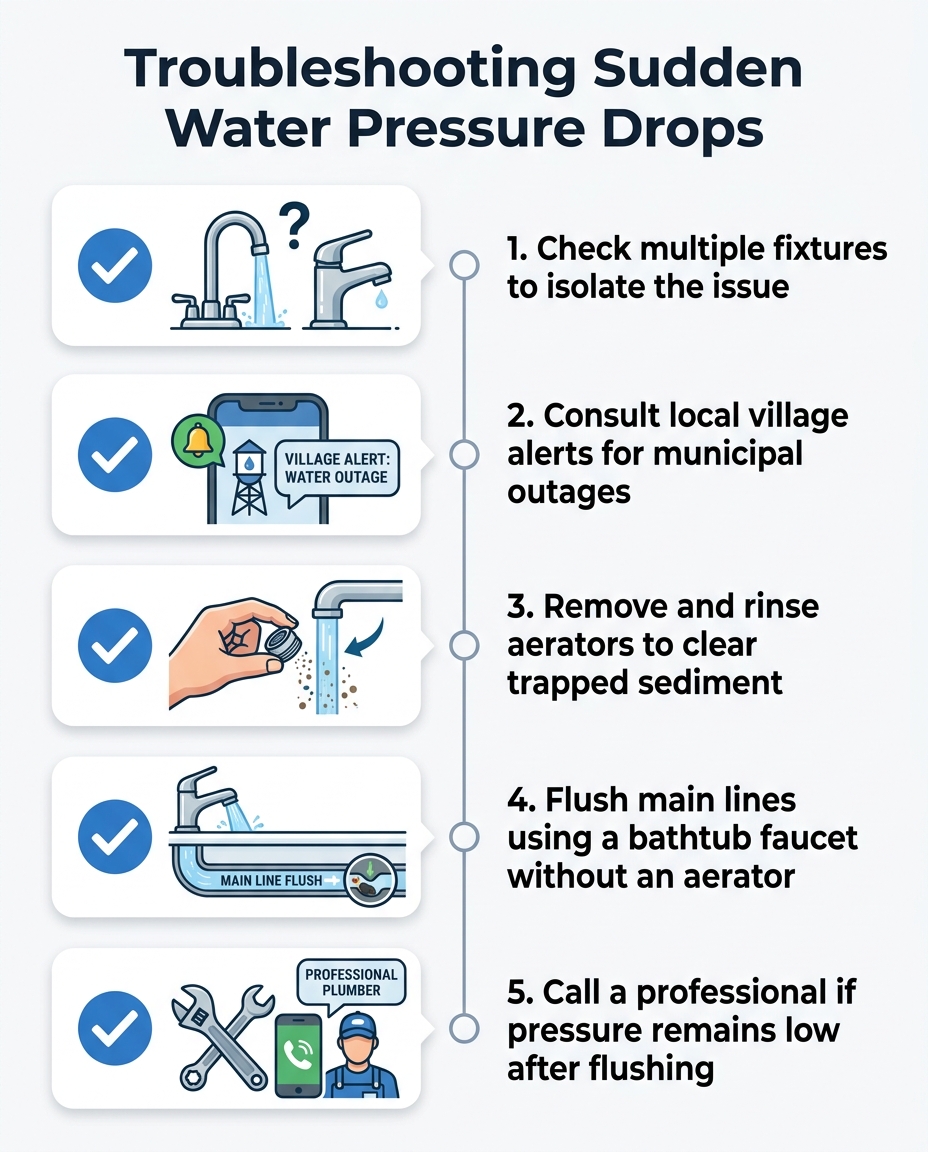
Check multiple fixtures throughout your home to see if the pressure loss is isolated to one room or systemic. A clogged showerhead in the master bath while the kitchen sink runs fine indicates a localized fixture issue. If every tap in the house is barely dripping, the problem is systemic. Next, consult local village alerts or community social media boards for notices regarding water main breaks or scheduled interruptions in Oakwood Hills. Municipalities frequently post emergency updates online when crews are dispatched.
• Test multiple taps: Check both hot and cold water at the highest and lowest points in your home.
• Check the village website: Look for active public works alerts or boil orders in your specific subdivision.
• Talk to your neighbors: A quick text to the house next door can confirm if the entire street is experiencing the same outage.
• Inspect the water heater: Ensure the shutoff valve on your water heater hasn't been accidentally bumped or partially closed.
If the issue is confirmed as a municipal outage, your best course of action is to simply wait for the city to restore service. However, if your neighbors have perfect pressure and there are no village alerts, the failure is isolated to your property. That is the exact moment it is time to contact an emergency plumber in Antioch to diagnose your internal system.

Once the village repairs the broken main and turns the water back on, a new set of challenges begins. A frequent issue our team at Countryside Plumbing Sewer and Septic encounters is that when a municipal water main is repaired and repressurized, the sudden, violent change in flow velocity stirs up decades of mineral deposits, rust, and sediment resting at the bottom of the city pipes. The water rushing back into the grid carries this debris with it.
This sediment travels through the underground supply lines directly into residential plumbing systems across Oakwood Hills. Because the debris is often microscopic or similar to fine sand, it easily bypasses standard property line meters. As the debris reaches the interior of your home, it follows the flow of water straight to your faucets and showerheads.
Modern plumbing fixtures are designed with water conservation in mind. They feature fine mesh screens, called aerators, which mix air into the water stream to reduce usage while maintaining apparent pressure. As the sediment-heavy water hits these screens, the debris frequently gets trapped. Within minutes of the water turning back on, these screens can become completely packed with rust flakes and calcium deposits.
This trapped sediment perfectly mimics the symptoms of low water pressure even after the village has fully restored municipal flow. Many homeowners mistakenly believe the city is still working on the lines, when in reality, the water is waiting just inches away, blocked by a clogged aerator. We recommend checking these screens first, as understanding this mechanical reality saves you from days of frustration.
If your pressure remains low after a confirmed summer outage, clearing the aerators is your first line of defense. We always advise Antioch homeowners to wait for the municipal water supply to fully stabilize before attempting to clear fixtures. If you clean them while the city is still flushing the hydrants, you will just have to repeat the process hours later.
1. Close the drain: Always plug the sink drain before you begin. Dropping small aerator parts down the drain turns a simple cleaning task into a retrieval mission.
2. Unscrew the aerator: Carefully unscrew faucet aerators by turning them counterclockwise. If they are tight, use a rag and pliers, applying minimal pressure to avoid scratching the finish.
3. Rinse the components: Disassemble the inner plastic flow restrictor and the metal mesh screen. Rinse them thoroughly under a different, running tap to remove trapped sediment.
4. Flush the bathtub: Run cold water through bathtubs or fixtures without aerators for several minutes. Tub spouts have wide openings and allow heavy sediment to flush out of your main internal lines without clogging.
5. Reassemble and test: Put the aerator back together and hand-tighten it onto the faucet. Turn the water on to verify that standard pressure has returned.
If flushing the fixtures does not restore pressure, or if drains begin backing up due to related blockages pushed through the system, professional drain cleaning may be necessary to clear heavier debris from the traps.
Patience is key when handling delicate plumbing components. Avoid using excessive force when removing aerators to prevent stripping the fine brass threads. If you encounter heavily calcified or stubborn aerator screens, soak them in a mild white vinegar solution for twenty minutes to dissolve the hard water buildup before scrubbing them.
Most importantly, do not attempt to dismantle complex plumbing valves, shower mixing cartridges, or the main pressure reducing valve (PRV) on your own. These components require specialized tools and calibration. Disassembling them without proper training can result in massive internal leaks. Our licensed professionals constantly remind customers to always leave main control valves to the experts.
There comes a point where troubleshooting must end and professional intervention must begin. If municipal service is fully restored, your neighbors have great pressure, and your aerators are clean, but your flow remains weak, a deeper plumbing failure has likely occurred. The sudden pressure spikes associated with water main restoration can sometimes be the final straw for aging internal plumbing.
Sudden pressure drops that persist after an outage can sometimes indicate an active, hidden leak or a failed pressure reducing valve (PRV) on the property. The PRV regulates the high pressure coming from the city down to a safe level for your home's pipes. In our years of servicing local utility systems, we've seen how a torn PRV diaphragm during a pressure surge can severely restrict water flow to the entire house, requiring immediate replacement.
Watch closely for signs of water pooling in the yard between your house and the street, which indicates a break in your private service line. Inside the home, be on the lookout for sudden damp spots in the basement drywall, unexplained puddles near the utility sink, or the sound of running water when all taps are off. These are indicators of an active leak.
When a true failure happens, local help is immediately available. Our team's 24/7 readiness ensures that if a pipe bursts after a city surge, you are never left waiting. Knowing the right steps for handling late-night plumbing issues—such as shutting off your main water valve immediately—can prevent extensive water damage while you wait for our technicians to arrive and secure the system.
Sudden drops are typically caused by municipal main breaks, high neighborhood demand, or a localized leak on your property. During the summer, extreme heat causes a spike in water usage for irrigation, which heavily strains the local infrastructure. If the drop is sudden and severe, the city has likely shut down a nearby main for emergency repairs.
The most common fix we recommend is removing and cleaning faucet aerators to clear sediment stirred up during the repair. When the city repressurizes the lines, rust and sand are pushed into your home, clogging the fine mesh screens on your taps. Unscrewing these screens and rinsing them out usually restores full flow instantly.
Keep faucets closed to prevent airlocks, turn off the water heater if the outage is prolonged, and wait for official restoration notices. Leaving taps open can cause a sudden blast of air and dirty water when the system comes back online. Monitor local village alerts to know exactly when it is safe to resume normal water usage.
Contact the local village water department first to check for outages or scheduled maintenance in your area. If they confirm that the municipal system is operating normally and your neighbors have good pressure, the problem is isolated to your property. At that point, contact a licensed plumber to diagnose your internal lines.
While sediment usually just clogs aerators, severe debris can occasionally foul internal valve cartridges if not flushed properly. Sand and grit can scratch the ceramic discs inside modern shower valves, leading to permanent drips. Flushing the heavy debris out through a tub spout before using sensitive fixtures helps prevent this damage.
Navigating sudden pressure drops requires knowing when to wait for the village and when to take action inside your home. By checking local alerts and safely flushing your aerators after an outage, you can resolve the majority of post-repair flow issues yourself. However, if your fixtures are completely clear but the pressure hasn't returned to normal, professional diagnostics are the logical next step. Reach out to the experts at Countryside Plumbing Sewer and Septic to evaluate your internal system, repair any hidden damage, and restore optimal performance to your home's plumbing.
See why homeowners trust us for reliable, responsive service and lasting plumbing solutions.

Jordan and his team are very responsive and helpful with all questions and issues related to our septic system. I can reference them with the highest regards!
Jordan is a great guy who seems to genuinely care about delivering quality work. Not only did he fix the problem quickly and efficiently, but also pointed out that the ejector pump in my basement had installed the wrong kind and that there were some other parts used that are not up to code.
Had a great experience with Countryside. Called with a fairly urgent issue and Jordan was responsive and out the house fast. Spent hours diagnosing my problem. Prices were competitive and he took the time to explain the situation and options. Highly recommend.
I reached out to Countryside this past June when the pipe from my house to the septic tank broke. Jordan responded to my call quickly, gave me a very reasonable quote, and immediately fit me into his schedule- which I was extremely thankful for because my yard was getting pretty smelly. Jordan is an expert in his field.
Jordan and his crew at Countryside just installed and hooked up a new septic tank for us. We could not be happier with the result! They are professional, easy to talk to, and kind. We highly recommend them,
Jordan and his team are very responsive and helpful with all questions and issues related to our septic system. I can reference them with the highest regards!
Jordan is a great guy who seems to genuinely care about delivering quality work. Not only did he fix the problem quickly and efficiently, but also pointed out that the ejector pump in my basement had installed the wrong kind and that there were some other parts used that are not up to code.
Had a great experience with Countryside. Called with a fairly urgent issue and Jordan was responsive and out the house fast. Spent hours diagnosing my problem. Prices were competitive and he took the time to explain the situation and options. Highly recommend.
I reached out to Countryside this past June when the pipe from my house to the septic tank broke. Jordan responded to my call quickly, gave me a very reasonable quote, and immediately fit me into his schedule- which I was extremely thankful for because my yard was getting pretty smelly. Jordan is an expert in his field.
Jordan and his crew at Countryside just installed and hooked up a new septic tank for us. We could not be happier with the result! They are professional, easy to talk to, and kind. We highly recommend them,
Jordan and his team are very responsive and helpful with all questions and issues related to our septic system. I can reference them with the highest regards!