Pre-Winter Septic Troubleshooting: Early Signs You Need Septic System Repair
What happens to shallow septic lines during a hard freeze? Apply these home maintenance tips and troubleshooting to protect your property before winter hits.
Peak summer in Northern Illinois is in full swing, and our team at Countryside Plumbing Sewer and Septic has seen firsthand that understanding exactly why sudden July thunderstorms overwhelm older sump pumps in Lake County is the key to keeping your basement dry this season. Peak summer weather brings a specific type of rapid-onset storm that behaves very differently from a slow, steady spring drizzle. An aging drainage system might easily handle a gentle multi-day rain event, lulling you into a false sense of security. However, when the skies open up and drop a massive volume of water in just twenty minutes, that same system will often fail spectacularly.
As a homeowner, you face a clear decision point right now: evaluate and proactively upgrade your aging equipment before the heavy weather hits, or roll the dice and risk a flooded basement during the next flash downpour. The damage from a single flooded lower level far outweighs the effort of a proactive upgrade. If you notice your system struggling to keep up with moderate rain, now is the time to act. Relying on professional plumbing services to handle your sump pump repair and replacement is the smartest, most secure path forward to protect your property.
To understand why a basement floods during a microburst, you have to look at the pure mechanical reality of water volume. Gallons Per Minute (GPM) is the standard measurement used to determine how much water your pump can physically move out of the pit and away from your foundation. When a severe summer storm hits, it can drop 1 to 2 inches of rain per hour. If your home has a 2,000-square-foot roof, just one inch of rain generates over 1,200 gallons of runoff. In a flash downpour, thousands of gallons of water are suddenly funneled directly toward your home's foundation in a matter of minutes.
The Capacity Mismatch: A standard 1/3 Horsepower (HP) residential sump pump typically handles roughly 35 to 40 GPM at a 10-foot lift (the vertical distance the water must travel to exit the basement). If sudden water ingress from a torrential downpour exceeds 40 GPM, the water level in the pit will rise faster than the pump can remove it.
• Light Spring Drizzle (0.25 inches/hr) — Water Funneled to Foundation (Approx.): 5-10 GPM — Standard 1/3 HP Pump Capacity: 35-40 GPM — System Status: Operating normally, easily keeping up
• Moderate Rain (0.5 inches/hr) — Water Funneled to Foundation (Approx.): 15-20 GPM — Standard 1/3 HP Pump Capacity: 35-40 GPM — System Status: Cycling frequently but managing the load
• Flash Downpour (1.5+ inches/hr) — Water Funneled to Foundation (Approx.): 45-60+ GPM — Standard 1/3 HP Pump Capacity: 35-40 GPM — System Status: Overwhelmed, pit overflows into basement
This mathematical mismatch is exactly why scheduling a proper sump pump installation in Antioch or the surrounding Lake County / Antioch IL area requires precise sizing. At Countryside Plumbing Sewer and Septic, our plumbing experts routinely evaluate your roof footprint, yard grading, and pit depth to ensure your new unit has the GPM capacity required to beat the math of a sudden downpour.
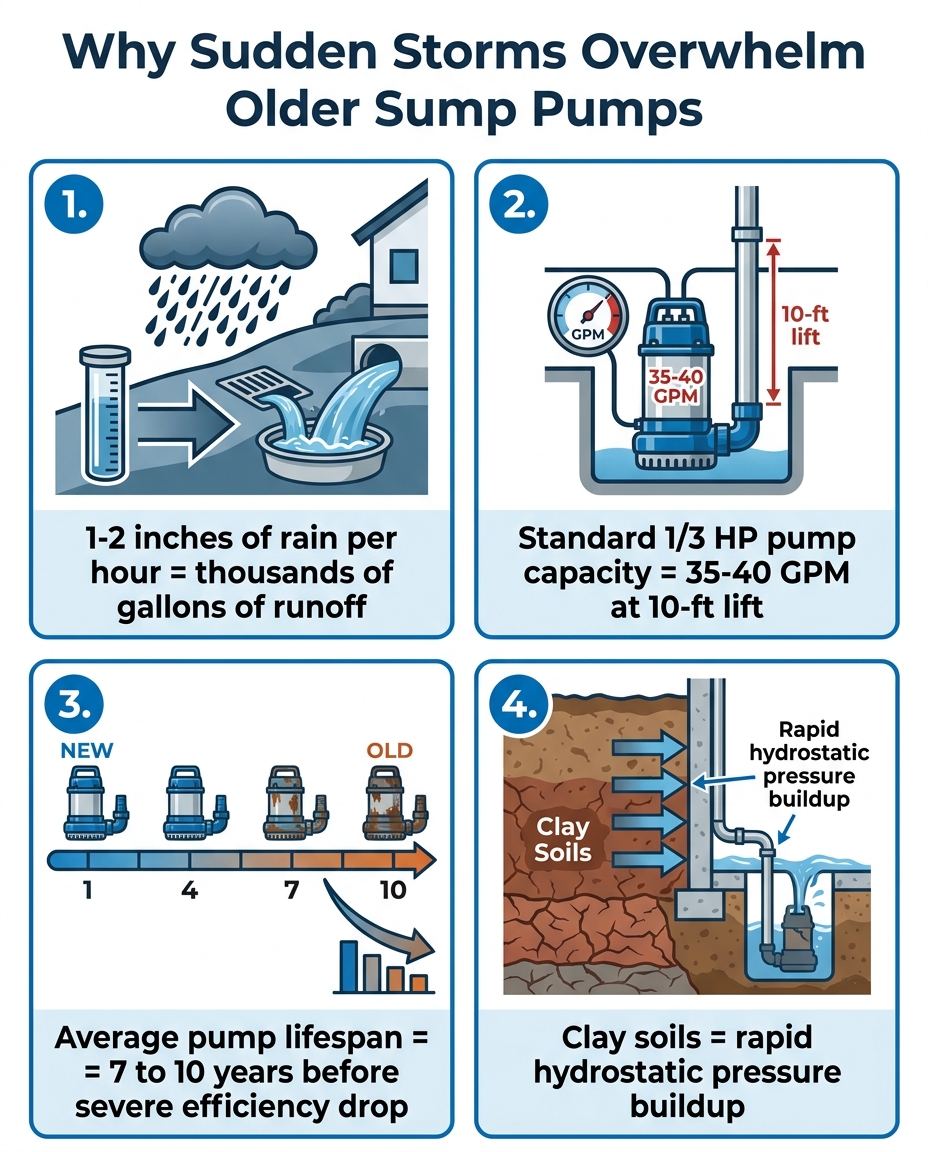

The topography and soil composition of Northern Illinois play a massive role in how quickly water threatens your basement. In our years of serving the Lake County / Antioch IL region, the team at Countryside Plumbing Sewer and Septic has found that the local soil is notoriously heavy in clay. Unlike sandy or loamy soils that allow rainwater to percolate slowly and deeply into the earth, clay-rich soil acts almost like a sponge that has already been tightly squeezed. It absorbs water very slowly. When a massive amount of rain falls in a short window, the clay simply cannot take it in, resulting in incredibly fast surface runoff.
Because the ground cannot absorb the flash downpour, the water table immediately surrounding your home spikes in a matter of minutes. This rapid buildup of water creates intense hydrostatic pressure—the physical force of standing water pushing against your concrete basement walls and floor.
As this pressure mounts, water is forced through every microscopic crack, cold joint, and window well, aggressively seeking the path of least resistance. That path leads directly into your drain tiles and straight into your sump pit. The clay-heavy environment turns a heavy rainstorm into a high-pressure water injection system directed right at your foundation, placing an extreme and sudden strain on your home's drainage equipment.
Many homeowners assume that if their pump turns on, it is working perfectly. The reality is much more complicated. Sump pumps generally have a functional lifespan of 7 to 10 years. When we pull out aging pumps from local homes, our team typically sees silent mechanical wear and tear that robs them of their original pumping capacity. An 8-year-old pump that was rated for 40 GPM out of the box might only be moving 20 GPM today, making it highly vulnerable to July summer thunderstorms.
Here is how the degradation process unfolds inside your aging equipment:
1. Impeller Wear: The impeller is the fan-like component that physically pushes the water up the discharge pipe. Over years of pumping gritty, sandy water, the plastic or cast-iron fins wear down. Smaller fins mean less water moved per rotation, drastically reducing your GPM.
2. Motor Fatigue: As the impeller wears down and bearings lose their lubrication, the electric motor has to work much harder to spin. This drops the motor's overall efficiency and causes it to run hotter than it did when it was new.
3. Thermal Relay Sensitivity: To prevent electrical fires, pumps have a thermal overload relay that shuts the motor off if it gets too hot. In an older, inefficient pump working desperately to keep up with a flash flood, the motor rapidly overheats. The thermal relay trips, shutting the pump off completely right when you need it most, leaving your basement unprotected until the motor cools down.
Catching these hidden efficiency losses before they result in a flood is exactly why our technicians highly recommend routine sump pump maintenance in Lake Villa and neighboring communities.
Even if your motor is functioning, the system is entirely dependent on the float switch—the mechanism that tells the pump when to turn on and off. During July summer thunderstorms, the rapid rise of the water table causes violent turbulence inside the confined space of the sump pit. Water does not just trickle in; it blasts through the inlet pipes, bringing silt, gravel, and debris with it.
Older systems frequently use a "tethered" float switch, which is essentially a buoyant bulb floating on the end of a cord. When the water rises, the bulb floats upward, tilting an internal switch to activate the motor. However, the violent, swirling water of a flash flood can easily push a tethered float against the side of the basin wall, pinning it underneath the discharge pipe or wedging it against debris.
When a float switch gets physically stuck, one of two disastrous things happens. Either the switch gets pinned in the "down" position, meaning the pump never turns on as the water rises and overflows into your basement. Or, the switch gets pinned in the "up" position, causing the pump to run continuously even after the pit is empty. A pump running dry will burn out its motor in a matter of hours. Upgrading to newer, vertical float switch designs that move straight up and down on a protected rod is a proven way we help homeowners mitigate this specific risk during violent water surges.
According to National Weather Service data, summer weather patterns in Northern Illinois frequently feature high CAPE (Convective Available Potential Energy). High CAPE environments provide the atmospheric fuel that drives severe microbursts. These weather systems bring not only torrential rain but also intense lightning and high winds, which frequently result in localized grid outages.
Relying solely on a primary, AC-powered pump during a severe storm is a massive vulnerability. If a lightning strike knocks out the power to your Lake County / Antioch IL neighborhood, your primary pump becomes completely useless, no matter how new or powerful it is. The hydrostatic pressure will continue to push water into your pit, and without power, your basement will flood rapidly.
This is where redundant pumping capacity saves the day. Dual-pump setups integrated with heavy-duty battery backups provide two layers of defense. First, they provide power redundancy, ensuring a secondary DC-powered pump takes over immediately if the grid fails. Second, in cases where the power stays on but the water volume exceeds the primary pump's limits, the backup unit can activate simultaneously, providing secondary GPM capacity to handle the overflow. In our experience responding to post-storm emergencies across Antioch, we always tell homeowners that planning a new sump pump setup with an integrated, smart battery backup is the absolute most reliable defense against unpredictable grid failures and extreme weather.
Waiting for a failure to find out your system is undersized is a costly mistake. You can proactively identify an undersized or failing system by performing a quick evaluation of your basement equipment before the heavy July summer thunderstorms arrive.
Your Pre-Storm System Checklist:
• Check the installation date: Look for a manufacturing sticker or installation tag on the motor housing. If the unit is over 7 years old, its GPM capacity has likely degraded significantly.
• Verify the horsepower (HP) rating: Check the label for the HP rating. A 1/3 HP unit is the minimum standard, but homes with larger footprints, deep basements, or high water tables often require a 1/2 HP or even 3/4 HP unit to handle flash floods safely.
• Listen during moderate rain: If your pump runs continuously or struggles to empty the pit during a standard spring rainstorm, it will absolutely fail during a severe downpour.
• Inspect the float switch: Fill the pit with a bucket of water and watch the switch activate. Ensure it moves freely without brushing against the basin walls or the power cord.
• Test the backup battery: If you have a backup system, unplug the main unit and fill the pit to ensure the battery holds a charge and the secondary pump activates smoothly.
Calculating the necessary GPM based on your home's footprint and the local soil conditions requires expertise. Professional evaluation by our team ensures your home is truly prepared for the worst weather the peak summer season has to offer.
Why does my sump pump run constantly during heavy rain?
Your pump runs constantly because the volume of water entering the pit matches or slightly exceeds the pump's removal capacity. During heavy rain, intense hydrostatic pressure forces water through your drain tiles rapidly. If your unit is older or undersized, it has to work non-stop to keep up, which can eventually lead to motor overheating.
How much rain can a standard sump pump handle?
A standard 1/3 HP pump can typically handle about 35 to 40 gallons per minute, which is usually sufficient for steady, moderate rain. However, a flash downpour dropping 1 to 2 inches of rain per hour on a large roof can generate over 50 gallons of runoff per minute. When the rainfall volume exceeds the pump's GPM limit, the system becomes overwhelmed.
How do I know if my sump pump is big enough for flash floods?
You can determine if your pump is big enough by calculating your home's roof footprint and comparing the potential runoff to the pump's GPM rating. If you have a large home, a deep basement, or live in an area with heavy clay soil, a standard 1/3 HP unit is likely undersized. Upgrading to a 1/2 HP or 3/4 HP model provides the extra capacity needed for flash floods.
Why did my sump pump fail during a storm when it worked yesterday?
Pumps often fail during storms because the sudden, violent influx of water causes mechanical components to jam or overheat. The turbulence can pin the float switch against the basin wall, or the continuous cycling can cause the aging motor's thermal relay to trip. What works for a slow trickle often breaks under the extreme stress of a rapid surge.
Do I really need a battery backup for my sump pump in Northern Illinois?
Yes, a battery backup is highly recommended in Northern Illinois due to the frequency of high-wind thunderstorms that cause power outages. If the grid goes down during a torrential downpour, your primary AC-powered pump will stop working entirely. A battery backup ensures your basement remains protected even when the neighborhood loses power.
How often should an older sump pump be replaced to prevent basement flooding?
Most residential pumps should be replaced every 7 to 10 years to maintain optimal protection. Over time, the internal motor parts and impellers wear down, significantly reducing the amount of water the unit can move. Proactively replacing the unit before it reaches the end of its lifespan is the best way to prevent unexpected flooding.
Now is the time to secure your home against the unpredictable nature of summer weather. Gaining a clear explanation of your current system's vulnerabilities and taking actionable steps to upgrade will keep your property safe and dry. Schedule your evaluation today to ensure your basement is fully protected before the next major storm hits.
See why homeowners trust us for reliable, responsive service and lasting plumbing solutions.

Jordan and his team are very responsive and helpful with all questions and issues related to our septic system. I can reference them with the highest regards!
Jordan is a great guy who seems to genuinely care about delivering quality work. Not only did he fix the problem quickly and efficiently, but also pointed out that the ejector pump in my basement had installed the wrong kind and that there were some other parts used that are not up to code.
Had a great experience with Countryside. Called with a fairly urgent issue and Jordan was responsive and out the house fast. Spent hours diagnosing my problem. Prices were competitive and he took the time to explain the situation and options. Highly recommend.
I reached out to Countryside this past June when the pipe from my house to the septic tank broke. Jordan responded to my call quickly, gave me a very reasonable quote, and immediately fit me into his schedule- which I was extremely thankful for because my yard was getting pretty smelly. Jordan is an expert in his field.
Jordan and his crew at Countryside just installed and hooked up a new septic tank for us. We could not be happier with the result! They are professional, easy to talk to, and kind. We highly recommend them,
Jordan and his team are very responsive and helpful with all questions and issues related to our septic system. I can reference them with the highest regards!
Jordan is a great guy who seems to genuinely care about delivering quality work. Not only did he fix the problem quickly and efficiently, but also pointed out that the ejector pump in my basement had installed the wrong kind and that there were some other parts used that are not up to code.
Had a great experience with Countryside. Called with a fairly urgent issue and Jordan was responsive and out the house fast. Spent hours diagnosing my problem. Prices were competitive and he took the time to explain the situation and options. Highly recommend.
I reached out to Countryside this past June when the pipe from my house to the septic tank broke. Jordan responded to my call quickly, gave me a very reasonable quote, and immediately fit me into his schedule- which I was extremely thankful for because my yard was getting pretty smelly. Jordan is an expert in his field.
Jordan and his crew at Countryside just installed and hooked up a new septic tank for us. We could not be happier with the result! They are professional, easy to talk to, and kind. We highly recommend them,
Jordan and his team are very responsive and helpful with all questions and issues related to our septic system. I can reference them with the highest regards!